
Use case — Web Development & Computing
API development and cloud concepts for education
API and cloud modules need environments where services actually run — endpoints to call, configuration to manage and deployments to reason about. Education Host delivers that through Cloud Pulse teaching labs, with hosted PHP endpoints on student web hosting where appropriate.
- Build and consume REST and JSON APIs in managed environments
- Practise authentication, environment variables and configuration concepts
- Cloud-style deployment experienced inside browser-based labs
- Hosted PHP API endpoints on student hosting where appropriate
- Identical environments for the whole cohort, reused each year
A use case supported by Education Host — platforms, hosting and infrastructure built exclusively for education.
The challenge: cloud concepts stay abstract without real environments
Students can read about services, APIs and deployment — but the concepts only land when they run something, call it and configure it themselves.
APIs need somewhere to live
An endpoint on localhost teaches half the lesson. Students need services running in an environment other machines can reach.
Configuration is the curriculum
Environment variables, secrets handling and service configuration are core cloud skills — awkward to practise safely on shared university machines.
Provisioning real cloud is risky
Handing students public cloud accounts brings cost surprises and governance headaches most departments would rather avoid.
How Education Host supports API and cloud teaching
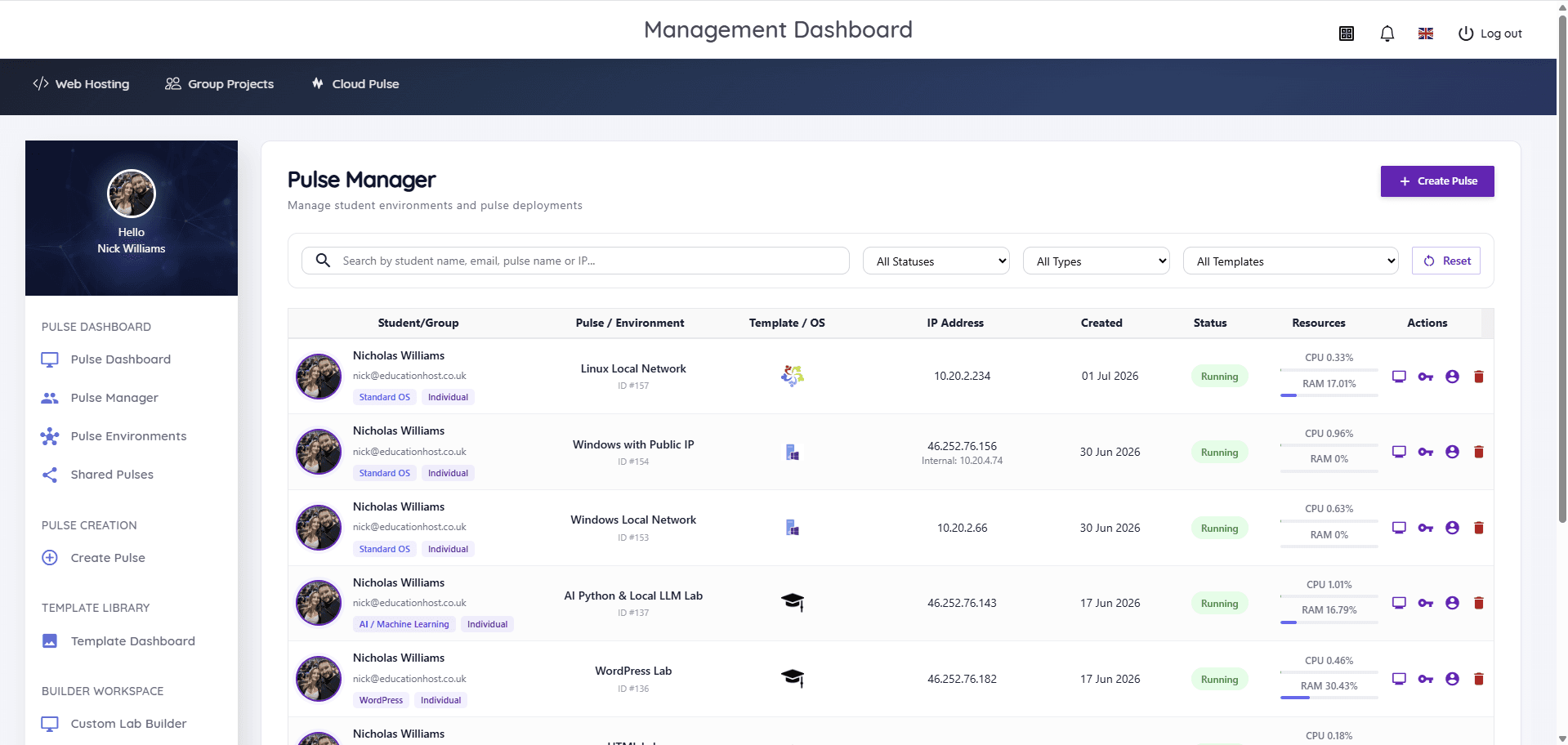
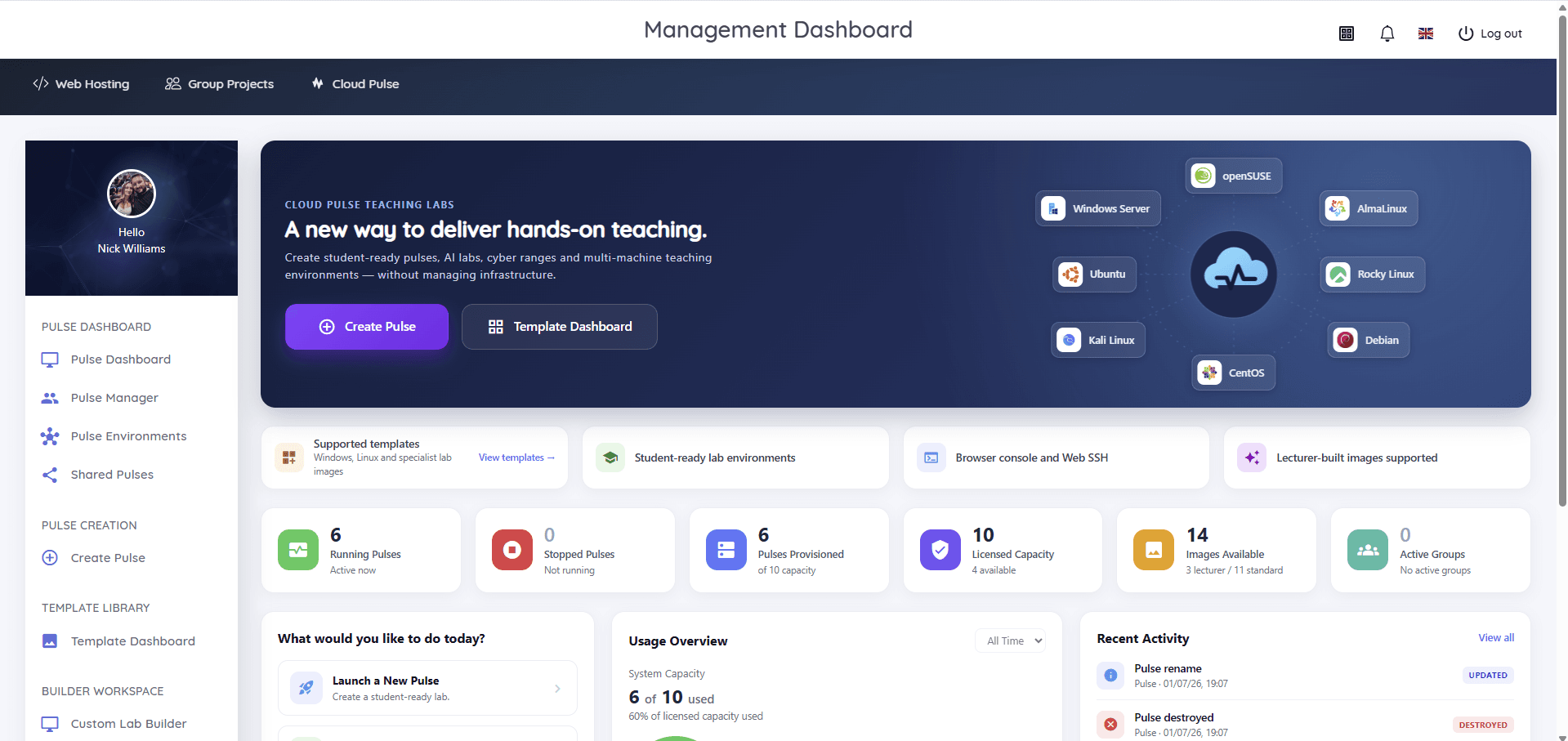
Cloud Pulse gives each student a managed education virtual machine where they can build, run and call services — deploying an API into their pulse, configuring it with environment variables and consuming it from other code. Lecturers define the stack per module, including Node.js and Python builds, and reuse the template every year.
Because pulses are provisioned on demand from templates, students experience cloud-style provisioning and deployment first-hand — inside institutionally governed environments rather than open-ended public cloud accounts. These environments can support teaching concepts such as microservices and deployment pipelines, with specific toolchains scoped per module. Simpler PHP endpoints can also run on Education Host student web hosting where appropriate.
- Per-student environments for building and running APIs
- Node.js, Python and PHP stacks defined by the lecturer per template
- Environment variables, configuration and secrets-handling exercises
- Private lab networking available for service-to-service exercises
- Cloud-style provisioning experienced through on-demand pulses
- Hosted PHP endpoints on governed student hosting where appropriate
What students and lecturers can do
Real services, called over real networks, inside managed labs.
- Build REST APIs returning JSON and call them from client code
- Practise authentication and token-handling concepts against their own endpoints
- Manage configuration through environment variables and settings files
- Explore microservice-style designs across machines in a lab environment
- Experience provisioning, deployment and teardown of environments
- Lecturers monitor every environment and drop into a console to assist
Example teaching activities
Coursework that brings cloud concepts down to earth.
Build-an-API assignment
Students design a small REST API with JSON responses, run it in their pulse and document its endpoints.
Configuration and secrets exercise
The same service deployed twice with different environment configurations — teaching twelve-factor thinking hands-on.
Consume-and-compose task
Client code that consumes a classmate's API inside the lab network, then composes several services together.
Deploy-and-scale discussion lab
Deploy the API from a template, observe live resource usage in Pulse Manager and discuss how real platforms scale.
Which Education Host platforms fit this use case
API and cloud concepts teaching is led by Cloud Pulse, with student hosting for simpler hosted endpoints.
Cloud Pulse
Browser-based computing labs for universities
Managed education virtual machines where students build, deploy, configure and call services — the core of the module.
Explore Cloud PulseStudent Web Host Manager
Governed student web hosting at institutional scale
Governed student hosting for PHP endpoints and hosted project work where the module needs a public URL.
Explore Student Web Host ManagerManaged Infrastructure
UK data-centre hosting, managed by Education Host
The monitored UK infrastructure behind the labs — no student-facing public cloud billing to govern.
Explore Managed InfrastructureTeaching outcomes
- Cloud concepts are practised, not just diagrammed
- Every student runs and calls real services in an identical environment
- Configuration and secrets-handling become muscle memory
- No public-cloud billing surprises or orphaned student accounts
- Module templates redeploy for every new cohort unchanged
Explore related use cases
Scenarios institutions often pair with this one.
Software engineering & DevOps
Git workflows, Linux environments and deployment thinking taught in browser-based labs that reset cleanly for every cohort.
Explore use caseBackend & database development
Server-side and database coursework on real hosting — PHP, MySQL, CRUD applications and data-driven projects with lecturer oversight.
Explore use caseFull stack development
Front end, back end, databases and deployment in one teaching setup — hosted web projects plus browser-based labs for the heavier stacks.
Explore use caseAI & Python teaching labs
Python, notebooks and AI fundamentals in browser-based labs — every student in an identical, lecturer-defined environment.
Explore use caseAPI development & cloud — frequently asked questions
Direct answers about this use case and the Education Host platforms behind it.
- What does API development and cloud concepts teaching involve?
- Students build and consume REST and JSON APIs, manage configuration through environment variables, and experience cloud-style provisioning and deployment — skills that need running services, not just slides.
- How does Education Host support API development teaching?
- Cloud Pulse provides per-student managed environments where students deploy and call their own services, with lecturer-defined stacks including Node.js, Python and PHP. Governed student web hosting can carry simpler PHP endpoints where a public URL helps.
- Does this replace giving students public cloud accounts?
- For most taught modules, yes. Cloud Pulse delivers the provisioning, deployment and configuration experience inside institutionally governed environments, without public-cloud billing risk or account clean-up.
- Can students practise microservices?
- Cloud Pulse environments can support teaching concepts such as microservices — including multi-machine lab designs with private networking — with the specific architecture scoped per module with the lecturer.
- Which Education Host platform is best for this use case?
- Cloud Pulse is the primary platform for API and cloud concepts teaching. Student Web Host Manager adds governed hosting where modules want endpoints on a public student URL.
- Is this suitable for universities and colleges?
- Yes. Cloud Pulse is built for higher education teaching, and the same templates scale from small option modules to large core cohorts.
- How do we start?
- Book a consultation with Education Host — we'll scope the API stacks and lab design your module needs and set up a template your cohort can use from week one.
See how this use case fits your institution
Tell us about your modules, cohorts and calendar, and we'll map this use case to the right Education Host platforms — including what to leave out.