
Use case — Web Development & Computing
Backend and database development hosting for students
Education Host supports backend and database modules with hosting students can actually build on — PHP and MySQL where enabled, database tools in cPanel, and account lifecycles that follow teaching blocks and deadlines rather than the other way round.
- PHP and MySQL hosting for server-side coursework, where enabled
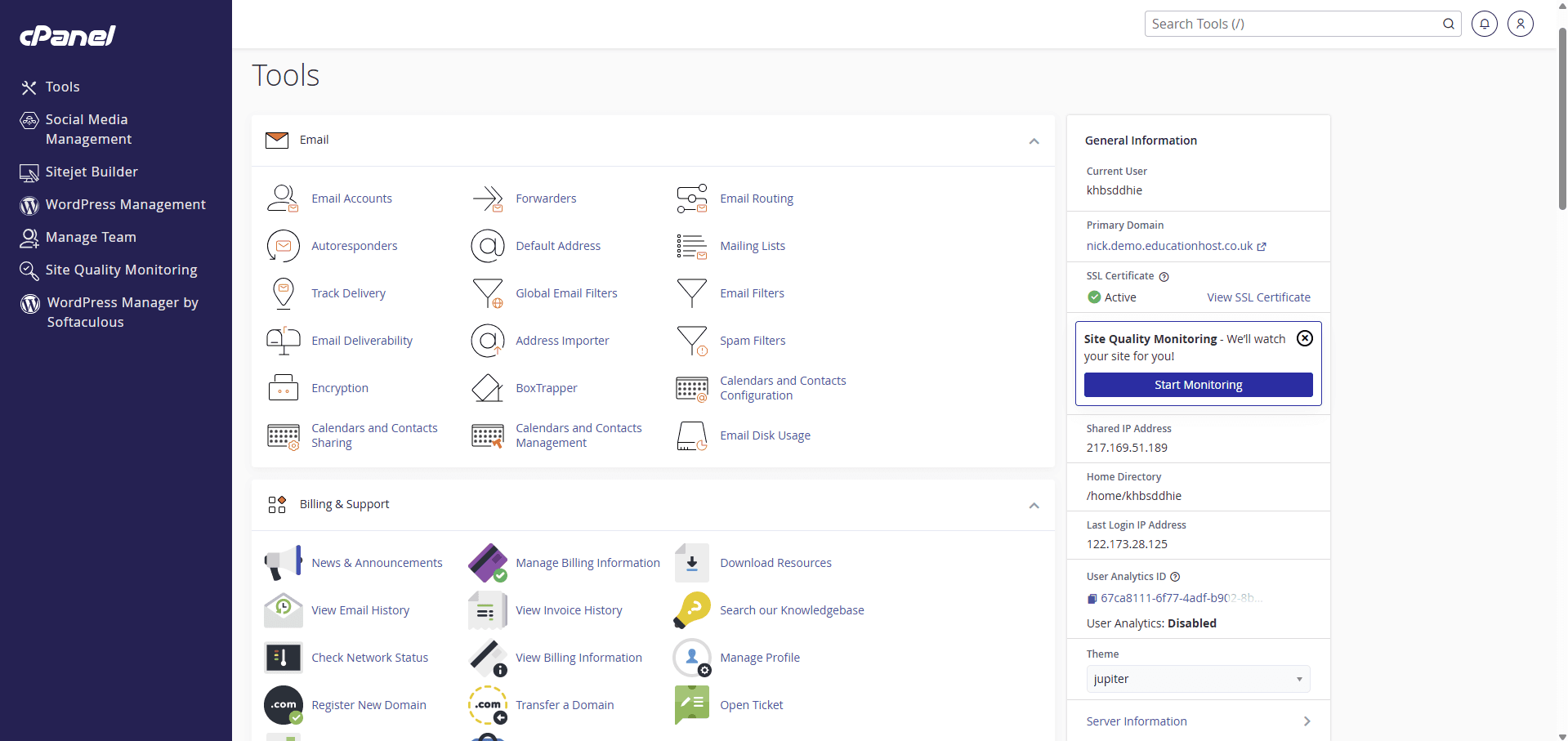
- Database creation and management through cPanel tools
- CRUD applications, authentication exercises and data-driven sites
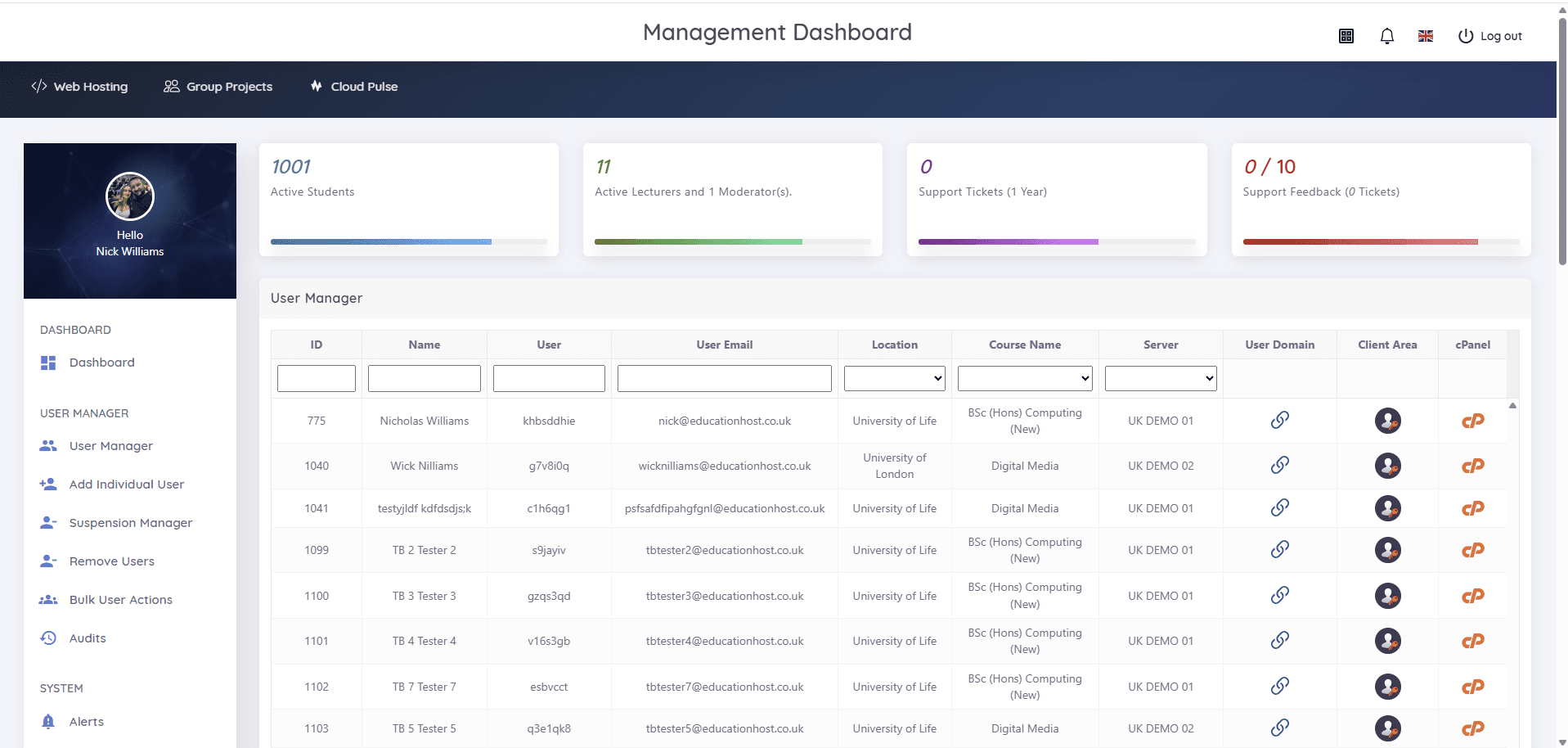
- Lecturer dashboard visibility across the cohort
- Account lifecycle aligned to teaching blocks and marking windows
A use case supported by Education Host — platforms, hosting and infrastructure built exclusively for education.
The challenge: database teaching needs more than a local install
Backend modules ask students to design schemas, write queries and build applications on top — and local-only setups keep getting in the way.
Every laptop is different
Local database installs vary by operating system, version and permissions. Time goes on fixing environments instead of teaching data design.
Applications need a server
CRUD apps, form handling and authentication exercises only feel real when they run server-side against a live database, not a mock.
Coursework must be assessable
Lecturers need to reach a student's working application and database at the deadline — hard when it only exists on a personal machine.
How Education Host supports backend and database teaching
Education Host student hosting gives each student a server-side environment with PHP and MySQL where enabled — databases are created and managed through cPanel tools, and applications run on a live URL lecturers can reach.
Student Web Host Manager wraps the cohort in governance: accounts provisioned in bulk or via enrolment workflows, Microsoft Entra sign-in, delegated lecturer access, and suspension aligned to teaching blocks, deadlines and marking windows.
- Per-student PHP and MySQL hosting, where enabled
- Database management through cPanel, including phpMyAdmin-style tools where available
- Live application URLs for demonstration and assessment
- Bulk provisioning and enrolment-workflow sync for whole cohorts
- Delegated lecturer visibility through Student Web Host Manager
- Suspension manager for module end, deadlines and marking windows
What students and lecturers can do
Real server-side work, with the admin handled centrally.
- Design and create MySQL databases for coursework
- Build CRUD applications with PHP against a live database
- Practise authentication, sessions and form-handling patterns
- Expose simple data endpoints for JavaScript front ends
- Lecturers open a student's live application when marking
- IT suspends the cohort at the deadline without per-account work
Example teaching activities
Backend coursework that works well on Education Host hosting.
Schema design assignment
Students design a relational schema, create it in MySQL and populate it through cPanel database tools.
CRUD application build
A PHP application with create, read, update and delete flows against the student's own database.
Authentication exercise
Login, sessions and password-handling patterns implemented and demonstrated on a live URL.
Data-driven mini-project
A small end-to-end project — schema, queries, server-side logic and a front end — submitted as a working site.
Which Education Host platforms fit this use case
Backend and database teaching runs on Education Web Hosting, governed at cohort scale by Student Web Host Manager.
Student Web Host Manager
Governed student web hosting at institutional scale
Provisioning, Microsoft Entra sign-in, lecturer visibility and deadline-aligned lifecycle controls for the whole cohort.
Explore Student Web Host ManagerEducation Web Hosting
Managed web hosting built for education
The PHP and MySQL hosting layer students build on, with database tools in cPanel where enabled.
Explore Education Web HostingManaged Infrastructure
UK data-centre hosting, managed by Education Host
Monitored UK data-centre infrastructure underneath the hosting, managed by Education Host.
Explore Managed InfrastructureTeaching outcomes
- Students practise database design and server-side development on real infrastructure
- Coursework is assessable at a live URL, not trapped on personal machines
- Consistent environments remove local-install variability from the module
- Deadlines are enforced by lifecycle controls rather than trust
- IT account administration stops scaling with cohort size
Explore related use cases
Scenarios institutions often pair with this one.
Web development courses
Give every student on a web development module real hosting — HTML, CSS, JavaScript and PHP on live URLs, provisioned and governed centrally.
Explore use caseDatabase coursework hosting
SQL teaching, schema design and data-backed coursework on hosted MySQL where enabled — with Cloud Pulse database labs where modules need a server of their own.
Explore use caseFull stack development
Front end, back end, databases and deployment in one teaching setup — hosted web projects plus browser-based labs for the heavier stacks.
Explore use caseAPI development & cloud
REST APIs, JSON, authentication and cloud-style deployment taught in managed environments students reach from any browser.
Explore use caseBackend & database development — frequently asked questions
Direct answers about this use case and the Education Host platforms behind it.
- What is backend and database development hosting?
- It is hosting that lets students build and run server-side coursework — PHP applications, MySQL databases, CRUD and authentication exercises — on real institutional hosting with a live URL, rather than only on their own machines.
- How does Education Host support backend and database modules?
- Education Host provides per-student hosting with PHP and MySQL where enabled and database management through cPanel, while Student Web Host Manager handles cohort provisioning, lecturer visibility and lifecycle controls aligned to teaching blocks and deadlines.
- Which Education Host platform is best for database teaching?
- Student Web Host Manager on Education Web Hosting is the usual fit: the hosting provides PHP and MySQL, and the management layer keeps the cohort governed around the academic calendar.
- Can students manage their own databases?
- Yes. Students create and manage MySQL databases through cPanel tools on their own hosting account, where the institution's setup enables database access.
- Can this support REST API coursework?
- Yes, for PHP-based endpoints on student hosting — and for fuller API and service work in Node.js or Python, Cloud Pulse teaching labs are usually the better fit. See the API development and cloud concepts use case.
- Can accounts be locked at the coursework deadline?
- Yes. Student Web Host Manager's suspension manager and lifecycle controls align account states to module dates and marking windows, so submissions stop changing when marking starts.
- How do we start?
- Book a consultation with Education Host — we'll scope your module structure, database requirements and student numbers, and confirm the right setup for your institution.
See how this use case fits your institution
Tell us about your modules, cohorts and calendar, and we'll map this use case to the right Education Host platforms — including what to leave out.